Thursday, September 18, 2014

Tenby

My first visit to Tenby. It is a town on the Pembrokeshire coast and still has its medieval walls. You can see the 13th Century walls behind me, I don't think the car park sign is quite that old.

In Welsh Tenby is Dinbych y Pysgod - Little Town of Fishes. The Normans strengthened the castle next to the town. After it was attacked by Llewelyn The Great the town walls were built. This was done by William de Valence, Earl of Pembroke. At times it appears this period of history seems to consist of somebody called Llewlyn attacking somewhere and a Norman called William building a wall or castle.

Tenby is where Henry Tudor sheltered (I think that's polite for hid from people with swords) before leaving the country during the Wars of the Roses. When he returned and became Henry VII the town benefited from royal grants.

The town suffered a decline after the civil wars. It lost a lot of its population and became very run down. Then Napoleon came along and rescued it - sort of. As rich people could no longer visit fashionable parts of Europe they started looking for places in Britain to go. Sir William Paxton built a 'bathing establishment' then a hotel and cottages. This attracted lots of the tourists who could no longer go to Europe. The towns revival continued into Victorian times.

Tenby is now a very pretty town. A cliff top road gives lovely views into the harbour. The centre of town is full of narrow streets with brightly painted Victorian shops.

Thursday, August 28, 2014

Big Pit - Blaenavon

I'm at Big Pit in Blaenavon, Wales. Big Pit is an old coal mine that is now a museum. You can even go down into the mine itself (bit like being home) where an ex-miner talks about mining, you can't take cameras or phones down there as there is still the risk of gas. Down in the mine there are still the stalls for the pit ponys.

Big Pit is an amalgamation of a number of mines, the oldest dating back to 1812. The main shaft at Big Pit was opened in 1860. It closed in 1980, though there is still plenty of coal down there. Above ground you can wander around and see the winch room for the lift, which is behind me in the photograph, and the miners baths. The baths were built in 1939, before that the miners had to go home to wash.

Blaenavon itself is a World Heritage Site due to it's role in the industrial revolution. Not far from Big Pit is the iron works.

Thursday, August 7, 2014

Epping Forest

This is Epping Forest. I like coming here as its nice and peaceful. I often see rabbits and deer (yum yum) running around.This is a hilly part of the forest. Here I'm on a railing at the bottom of a hill, the path crosses a small stream then goes up another hill. Sometimes it's easier to fly, especially when it's muddy. There's a lot of mud in the forest at times and it gets stuck on my claws which I don't like. The other good thing about flying there is it startles the birds of prey, they aren't used to dragons.

Epping Forest stretches from east London to Epping in Essex. It's about 13 miles long with a mixture of open grassland and forest. So there's plenty of space for me to explore.

Wednesday, July 16, 2014

Chepstow Castle III

A couple more photos at Chepstow Castle. As the castle was built in stages along the river Wye it has an unusual shape. It is a series of terraces stretching along the cliff top.

During the civil war the castle was besieged twice, in 1645 and 1648. It was defended by the Royalists. The Parliamentarians captured it in 1648. After the war it was garrisoned and used as prison. When it stopped being used a castle it started falling in to decay. Its uses including a farmyard and a factory.
By the late 18th C the castle was a popular sight for tourists. Conservation work started in 1914 and in 1953 it was put in the care of the Ministry of Works. The castle has been used in the making of two films, the 1913 version of Ivanhoe and 1977's Jabberwocky. I think they would both have benefited from an appearance by a proper red dragon.

Thursday, June 12, 2014

Chepstow Castle II

They must have been expecting me at the castle as this nice throne was ready for me, well it's what a Welsh dragon would expect when visiting a castle.

In the 1190's the castle was expanded by William Marshall (Normans were rather fond of 'William' as a name). He built the main gatehouse and strengthened other parts. After his death his sons (including a William!) continued building.

In 1270 the castle passed to Roger Bigod. He also expanded the castle. Adding new accommodation for his family, remodelling the Great Tower and building a new tower - Marten's Tower. He also built Chepstow town wall. I'm surprised the Normans had time for fighting as they must have been very busy building all these castles and walls.

Thursday, May 8, 2014

Chepstow Castle

I'm visiting Chepstow, it's a handy place to stop travelling from Cardiff to London. The Normans started building the castle in 1067, one year after the conquest of England. Making it the oldest non-Roman stone fort in Britain. It was built for William FitzOsbern, a relative of William the Conqueror. FitzOsbern was first given control of the Isle of Wight then made Earl of Hereford. This part of England wasn't under full Norman control and bordered Wales. The Welsh were independent of England back then, though the Anglo-Saxons had invaded Wales a few times, with King Harold being the most recent and successful before he became king. This castle will have helped impress and intimidate the Anglo-Saxons still fighting and the Welsh.

Thursday, April 17, 2014

Nereid in Cardiff

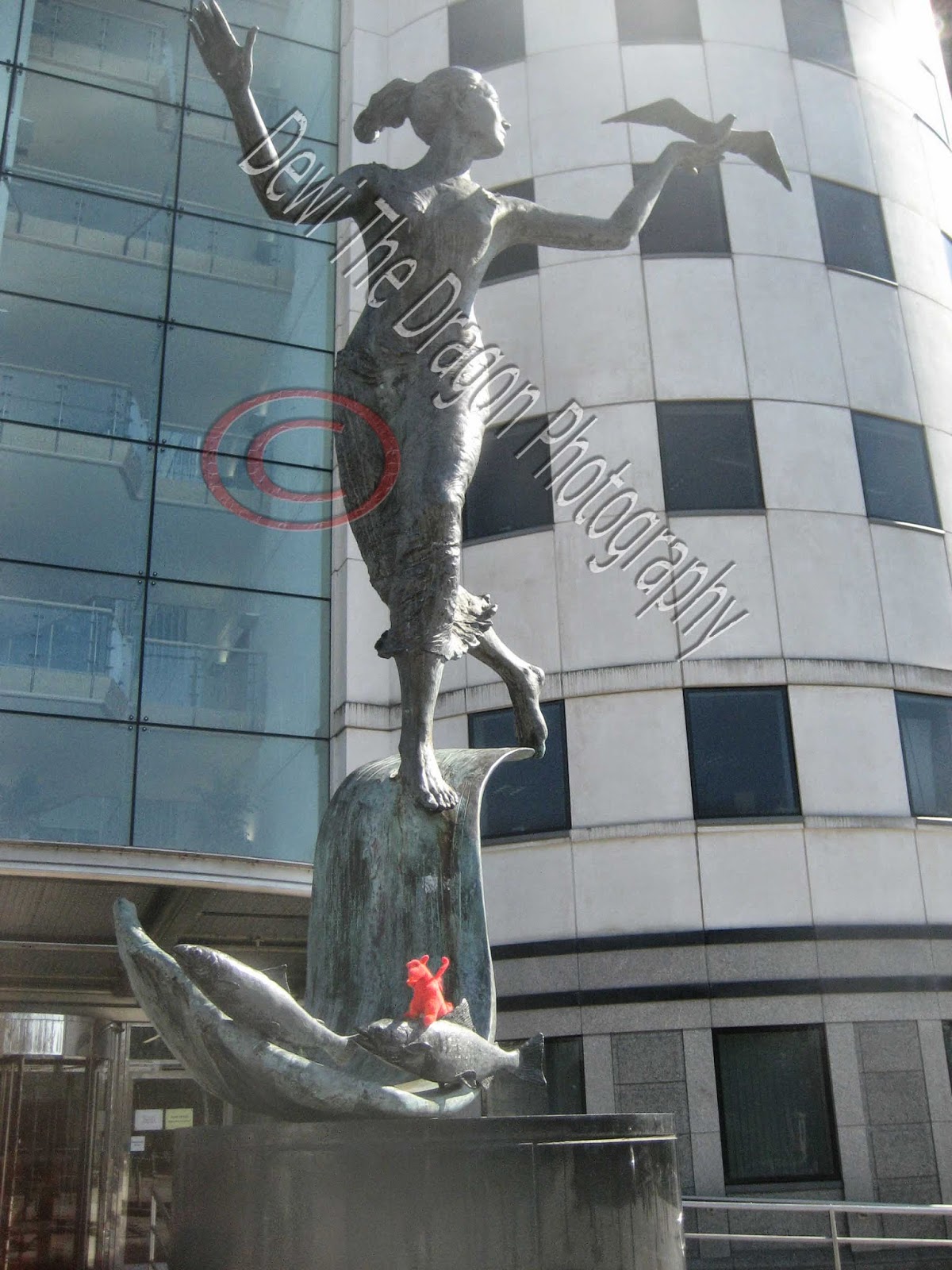
Another visit to Cardiff. I met this Nereid, she wasn't doing any guided tours to the city - dragon or not. She seemed a bit occupied with that bird on her hand, so I sat on a fish and posed for the picture.

Nereids are sea nymphs from the Aegean Sea -this one's a bit lost. They are the fifty daughters of Nereus and Doris (sounds like they might really be from the East End). The Nereids would go to the aid of sailors in heavy storms. This one looks like she goes to the aid of birds as well. I didn't spot any of the other 49, nor Doris. Though she was probably having a knees up round the piano in some pub.